
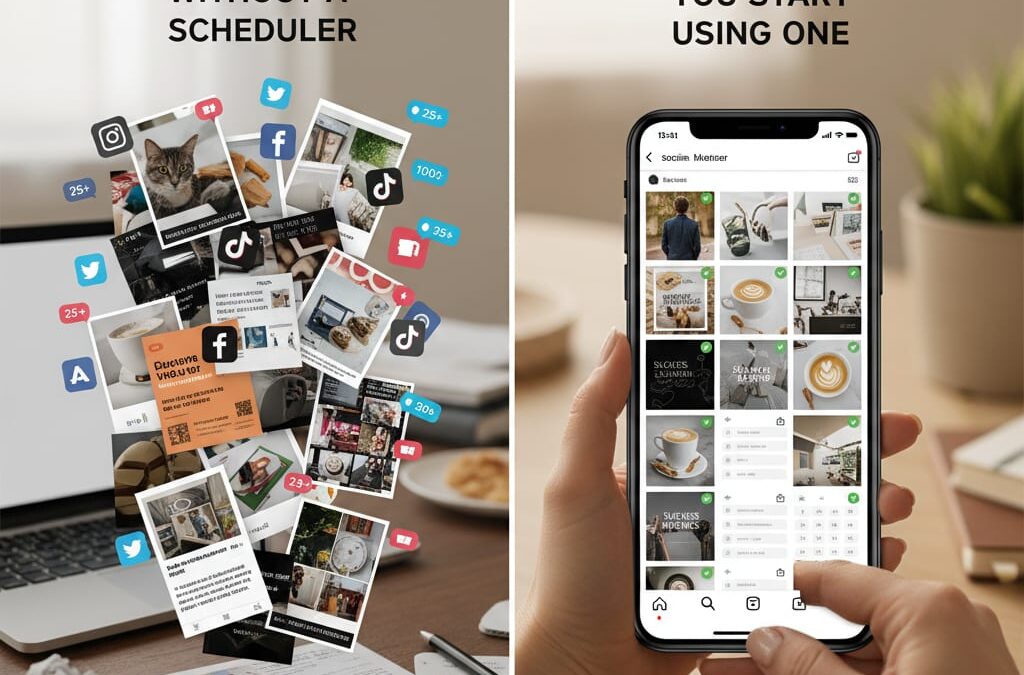
What Your Social Feed Looks Like Without a Scheduler (And 60 Days After You Start Using One)
Most small business owners already know they should be posting more consistently. The problem isn’t awareness – it’s that life gets in the way, and before you know it, your last Instagram post was three weeks ago and your Facebook page looks like a ghost town.
Here’s what that actually costs you. And here’s what 60 days of scheduled, consistent posting looks like instead.
—
What Does a “Winging It” Social Feed Actually Look Like?
A typical unscheduled small business feed follows a boom-and-bust pattern: a flurry of posts during a quiet week, then radio silence for 10-21 days whenever things get busy.
It usually goes like this. You post three times in one week when you have a free afternoon. Then a big order comes in, or a staff member calls in sick, and social media drops completely off the list. Three weeks later, you post again – often something rushed, off-brand, or with a typo you notice the next morning.
The gaps tell a story to your audience. When someone discovers your business on Instagram and scrolls back to find your last post was from a month ago, they quietly wonder if you’re still open, still reliable, still worth following.
The data backs this up. Accounts that post fewer than three times per week on Instagram see up to 50% lower reach than those posting five or more times, according to Hootsuite’s 2023 Social Media Trends report. Engagement doesn’t just plateau during ghost periods – it actively declines, and rebuilding it takes longer than most people expect.
—
What Are the Real Costs of Inconsistent Posting?
Inconsistent posting doesn’t just hurt vanity metrics – it directly damages trust, reach, and the algorithm’s willingness to show your content to new people.
Here’s what typically happens during a 3-week ghost period:
- Reach drops. Platforms like Instagram and Facebook reward accounts that post regularly. A long gap signals low activity, and the algorithm pulls back your distribution.
- Follower growth stalls. New visitors land on a sparse feed and don’t follow. Why would they? There’s no evidence of regular value.
- Engagement takes time to recover. After a posting gap, your first few posts back tend to underperform – sometimes for 1-2 weeks – before the algorithm re-warms to your account.
- Brand trust erodes. Inconsistency reads as unreliability, even when it’s just busyness. Customers conflate the two.
—
What Changes at 30 and 60 Days With a Content Calendar?
At 30 days of consistent, scheduled posting, most small business accounts see measurable improvement in reach and follower growth. By 60 days, engagement rates typically stabilise and compound.
Here’s a realistic progression:
Days 1-14: The first two weeks feel slow. You’re publishing consistently, but the numbers don’t jump immediately. This is normal – algorithms take time to register the change in behaviour.
Days 15-30: Reach starts to improve. Accounts that move from posting once a week to four or five times a week often see a 30-40% lift in organic reach within the first month. Follower growth begins to tick upward more steadily.
Days 31-60: This is where it compounds. Your content library is now bigger, your audience has more reasons to engage, and the algorithm is treating your account as an active one. Brands that maintain this cadence for 60 days report that their average post now reaches 2-3x more people than it did during their inconsistent period.
The other thing that happens at 60 days? Posting stops feeling like a crisis. When content is planned and queued, you’re not scrambling every Tuesday morning trying to think of something to say.
—
How Does a Scheduler Actually Make This Sustainable?
A social media scheduler removes the decision fatigue from daily posting by letting you batch-create content once and publish it automatically across platforms throughout the week or month.
With a tool like Feedalpha, a small business owner can sit down for 90 minutes on a Monday, plan the week’s content with the help of AI content suggestions, schedule it across Instagram, Facebook, LinkedIn, and X, and then not think about it again until next Monday.
That’s it. The posts go out on time, on brand, every day – even when you’re in back-to-back meetings or dealing with a delivery that’s gone sideways.
For teams, it also means someone can draft posts, a manager can approve them, and nothing goes live without a second pair of eyes. No more accidental posts, no more off-brand captions, no more “who posted that?”
—
FAQ
How long does it take to see results from consistent social media posting? Most accounts see measurable reach improvement within 15-30 days of consistent posting. Full engagement recovery after a long gap typically takes 45-60 days.
How often should a small business post on social media? For most platforms, 4-5 times per week is the sweet spot for small businesses. Quality matters, but frequency is what tells the algorithm your account is active.
Can AI really help with content ideas for a small business? Yes. AI content tools can generate post ideas, captions, and hashtag suggestions based on your industry and audience – cutting the blank-page problem that causes most posting gaps in the first place.
What’s the difference between scheduling posts manually and using a dedicated tool? Manual scheduling (native platform tools) requires you to be at your desk at posting time and doesn’t easily manage multiple platforms. A dedicated scheduler like Feedalpha queues everything in one place, posts automatically, and gives you analytics across all platforms in one dashboard.
Does posting more often mean lower quality? Not if you batch your content creation. Planning a week of posts at once – rather than writing each one on the day – actually tends to improve quality because you’re not rushing.
—
The bottom line: the gap between a struggling social feed and a consistent, growing one isn’t talent or budget. It’s a system. Sixty days of scheduled, planned content will do more for your social presence than years of sporadic posting. The only question is when you want to start the clock.